

Liraglutide
Liraglutide
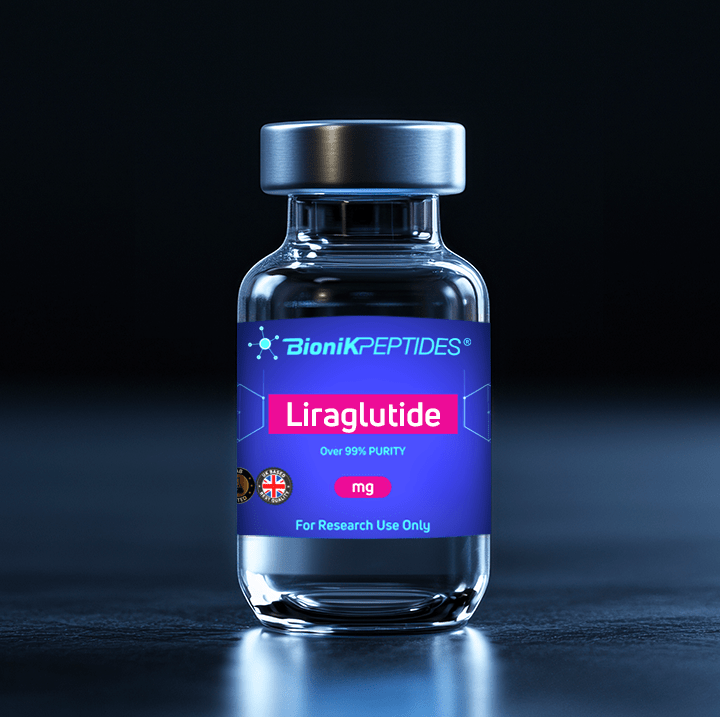
Bionk Peptides delivers high-performance research compounds engineered with uncompromising attention to detail. Every vial is produced to exceed 99% purity and supplied in lyophilised powder form, preserving molecular integrity while ensuring optimal stability and precision in application. Bionk Peptides are commitment to elevated research performance. For laboratory research only. Not for human use.
Couldn't load pickup availability
Description
Liraglutide
Liraglutide is a synthetic peptide analogue of glucagon-like peptide-1 (GLP-1), designed to interact with the GLP-1 receptor. It is a modified form of the naturally occurring GLP-1 peptide with structural changes that increase its stability and extend its activity.
In laboratory research, liraglutide is studied to investigate GLP-1 receptor signalling, glucose-regulation pathways, peptide stability and metabolic signalling. Experimental models may examine its effects on insulin-related signalling, cellular metabolism and appetite-regulation pathways.
Liraglutide is widely used as a research tool in metabolic, endocrine and peptide pharmacology studies, particularly for investigating GLP-1 receptor activity and downstream cellular responses.
Laboratory Research Data Analysis
- Peptide identity: LC-MS / mass spectrometry
- Purity assessment: HPLC analysis
- GLP-1 receptor studies: receptor binding and activation analysis
- Signalling pathways: investigation of cAMP and downstream cellular markers
- Metabolic pathway research: analysis of glucose and energy-regulation pathways.
- Peptide stability: evaluation under controlled laboratory conditions
- Dose-response studies: comparison of concentration-dependent responses
- Cell-based assays: analysis of receptor activity and cellular signalling
- Data analysis: statistical comparison, trend analysis and reproducibility testing
- Research classification: metabolic, endocrine and peptide pharmacology research

